By Bob Hicks
The family tree just keeps getting bigger and bigger. Or the roots get more and more tangled.
This morning’s most intriguing news was the revelation that, yes indeed, Neanderthals seem to be among our ancestors. At least, a team of biologists doing DNA analysis of Neanderthal bones has determined tentatively that between 1 and 4 percent of non-African contemporary humans’ genome derives from that brawny, slope-headed side of the family. Once upon a time most scientists pretty much figured there’d been intermingling. Then they decided there hadn’t been. Now, it seems, caveman sex was pretty liberal, after all.
Several versions of this story are floating around. We like Nicholas Wade’s report in the New York Times, because it’s complete for a general audience and comes with the necessary cautions that more research needs to be done and not all scientists agree that the evidence leads to the conclusion. Even in matters sexual, peer review is important.
Here at Art Scatter World Headquarters we have a longstanding interest in the prehistoric links between culture and biology. We’ve talked about them in relationship to natural selection in the Pleistocene era and celebrated the discovery of Ardi, our 4.4 million-year-old beauty of a cousin. Something’s been making the world go ’round for a long, long time.
We also note with gleeful irony that today’s announcement comes as bad news for the rear-guard intellects of the Aryan Nations: Because this interbreeding hanky panky took place in the Middle East, after humans had migrated there from Africa but before the wanderers had split off into their European and Asian arms, the shared genetic material isn’t found south of the Mediterranean. In other words: If there’s such a thing as a “pure” race, it’s in Africa. Ha!
*
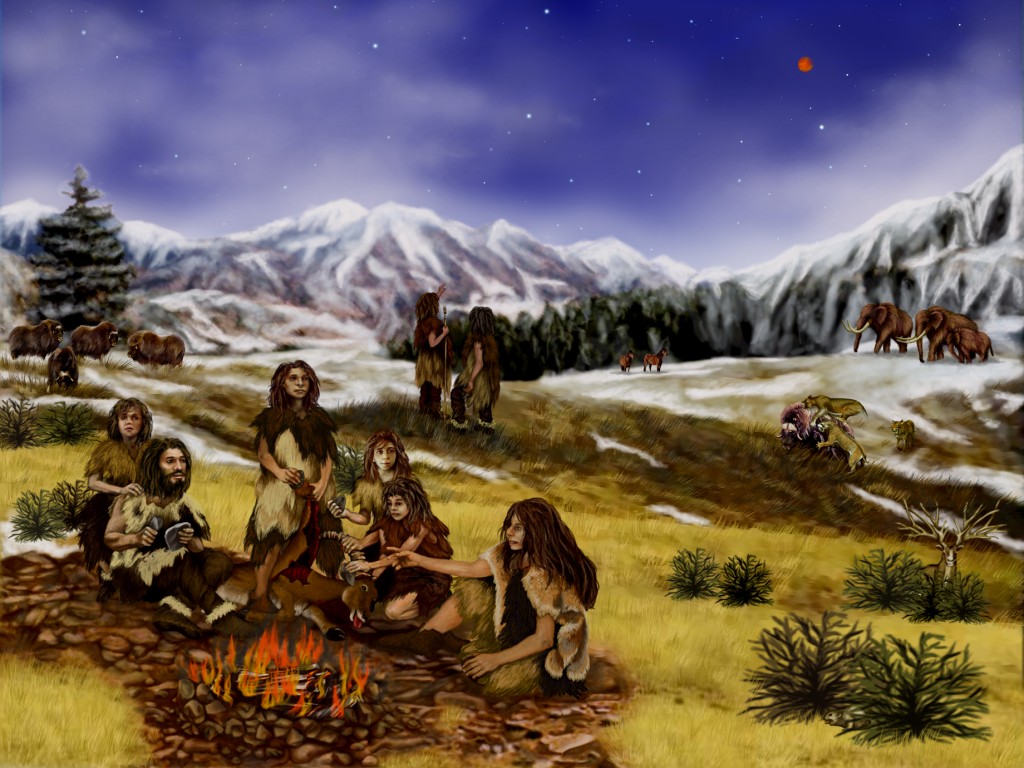
Illustration: National Aeronautics and Space Administration artist’s rendition of a family of Neanderthals about 60,000 years ago. The extinct animals of the Pleistocene epoch pictured are the Woolly Mammoth, the Bush Antlered Deer, and the Sabre Toothed Cat. Pleistocene animals in this image that still exist are the Eurasian Horse, the Oryx, the Banded Lemming and the Musk Ox. Some of the plant life of the Pleistocene epoch consisted of grasses (which did not exist until this time), ferns, trees, sedges and shrubs.
 This four-hand feat, by the way, will come just before Mrs. Scatter’s departure on her own quest, this one to far London town on the trail of Tates
 Howard is one of the founders of the story theater, and so it was fitting that his hour-long piece, The Adventures of Huckleberry Horowitz, kicked the festival off. Most everyone knows the mystical power of chicken soup, and most understand the pull of ritual and tradition in that thing we loosely call religion, so Howard’s audience, maybe 65 or 70 strong, rippled into laughter: the easy, familiar kind, the kind that says, “Yeah, we know what you mean.”
 I put my bag on the floor and moved a portable potty out of the way to give her a sideways hug.
 I am more than a little envious that he got this assignment. I’m the one who’s had my eye on this show for months. I’m the one who
  “Excuse me?” I said. “You got to meet him?”
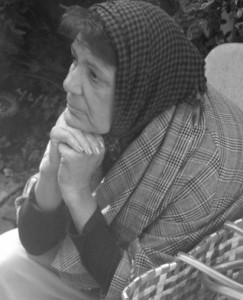 “Rose’s life sometimes seems too exemplary to be true,” Nightingale writes. “Add some convenient coincidences to her tale — like meeting a bitter old shopkeeper in the Arizona desert and realizing he is the spouse she thought she had lost to Dachau — and Rose could easily be a case study rather than a character.”
 Ms. Alsop is
  In
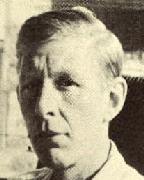
In 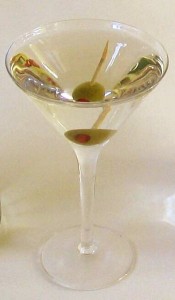 In 1963 I had the honor of hosting Auden, who was giving a reading at a community college I attended at the time. There was a dinner and reception before the reading, during which he drank, by my own nervous count, a dozen martinis! And seemed drunk. We didn’t know what to do, and when approached he assured us all was fine, no, he didn’t want any coffee …. so off we went to the reading, nervous as hell. He still seemed drunk to me when he went to the podium. Then somehow he didn’t. He gave a brilliant, flawless reading. Then he stepped away, seemed drunk again, and wanted to know when he could have a drink.
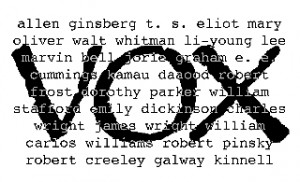 It’s the latest in Eric Hull‘s
  Waterbrook is basically a room with an entrance area and a door leading to what serves as a green room for the performers. Somewhere around the corner, down a broad-plank floor, is a restroom. On Saturday the performance space had a few rows of folding chairs for the spectators, a lineup of music stands up front for the six performers, and three chairs to the side for the performers who occasionally sat a poem out. In other words: all the tools you really need to create some first-rate performing art.