One of the advantages in this Day of the Download to maintaining actual bookshelves is that you browse through them now and again, looking for things you’ve read before that you might want to read again. I’m a proponent of re-reading, and I’ve come to trust my sense of when it’s time to pick up a book and give it another shot.
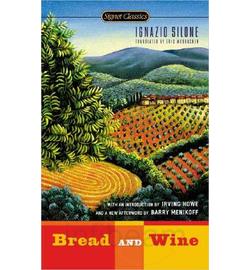 So one day last week I picked up my old copy of Ignazio Silone‘s Bread and Wine, a classic Italian novel that is celebrated for its anti-fascist and anti-communist leanings (Silone is often abbreviated as the Italian George Orwell) but which is at least as much, it seems to me, a reflection on the nature of the church and the chasm between organized religion and true morality.
That this reflection comes from a writer who has been accused by historians of spying for the fascists in the 1920s is something I can’t explain, except to suggest that the most potent condemnations of specific wrongs sometimes come from those who are tempted most mightily by them. And if, indeed, Silone was a police informant as a young man, it lends a deeper resonance to Bread and Wine, a story that includes a key character who has informed on his communist cellmates and later come to terms with his motives and actions, bravely enduring a Christlike death. Silone is extraordinarily understanding and insightful about this character, whose path to saintliness echoes the imperfections and weaknesses of Jesus in Nikos Kazantzakis‘s novel The Last Temptation of Christ, except that the Greek writer’s man/god, while tempted to the point of torment, doesn’t give in.
Silone wrote this novel in exile in 1935, when Mussolini and his crowd were riding high and had just gone a-venturing in Abyssinia, prowling for the spoils of victory. He rewrote the book in 1955, seeking to make it sparer and cleaner, and the version I have was published in 1986, which is I imagine when I first read it. That was my second go-round. I’d also read the novel in college, in the late 1960s, for the same class in which I read The God That Failed, the 1949 book of essays by Silone, Arthur Koestler, Richard Wright, Andre Gide, Louis Fischer and Stephen Spender about how they became disenchanted with communism. Surely it means something that I’ve read Silone’s book at about age 20, and about 38, and now at 61, and each time it’s felt like a fine wrestle with literature that matters.
Continue reading On the bookshelf: Ignazio Silone’s ‘Bread and Wine’
 I don’t speak French, so that basically meant to me, “blah blah blah blah ORGY.” And I’m invited.
 She came to visit and brought me a new nozzle. It has rhinestones.
 Oops. Wrong award ceremony.
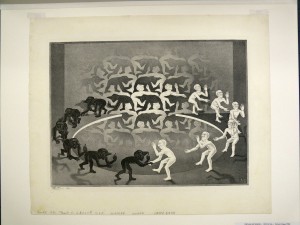 M.C. ESCHER at the Portland Art Museum: Truly an artist for the Age of Engineering — a draftsman for the dreamers, a dreamer for the draftsmen. On Saturday the museum opens Virtual Worlds: M.C. Escher and Paradox, and somehow that’s got us us humming a tune from The Pirates of Penzance:
 GIFTS OF HONOR at the Portland Art Museum: This very good show has been up since the end of last August in the museum’s Marge Riley Education Gallery, which straddles the museum’s two buildings, but it ends June 30, and you should try to catch it before it disappears.
 Yes, long before the parade started, when people were still scarce, a driver held his hand out of a passing van and released two butterflies.
 Perhaps if the poetry cards go away, riders could start carrying around books of poetry — reading them, exchanging them, passing them around. TriMet could have stacks of books on the bus, donated by riders, free for the taking and dropping off again.
 How do I tell my husband that I’m heating water because our bathtub drain is plugged? As I shower, the water slowly rises to my ankles until I cry for help, quickly rinse and turn off the faucet. Then the water slowly recedes, leaving a gray filthy mess. This isn’t pleasant. It grosses me out.
 You’ve read
  *************************